Onshore wind power uses turbines on land to turn the kinetic energy of moving air into electricity, with no fuel burned. Blades spin a rotor, the rotor drives a generator, and cables carry the output to the grid.
It is one of the main technologies covered in the renewable energy guide, which compares it with solar, storage and other options.
| Key fact | Detail |
|---|---|
| Wind turns the blades, rotor and generator | rotor to generator |
| Lift stronger than drag spins rotor | lift > drag |
| Typical blade length | A typical modern land-based turbine has blades of over 170 feet (52 meters), per the Department of Energy |
| Controller start and shutoff speeds | The controller starts the machine at about 7–11 miles per hour (mph) and shuts it off when wind exceeds 55–65 mph, per the Department of Energy |
| Taller towers capture more energy | height |
| Nacelle contents | Holds the gearbox, shafts, generator and brake |
Figures from www.energy.gov; they can change, so check the source before you rely on them.
What onshore wind power is
The U.S. Department of Energy explains that wind is a form of solar energy caused by a combination of three concurrent events: the sun unevenly heating the atmosphere, irregularities of the earth’s surface, and the rotation of the earth. As long as the sun heats the planet, air keeps moving, which is why wind counts as a renewable resource.
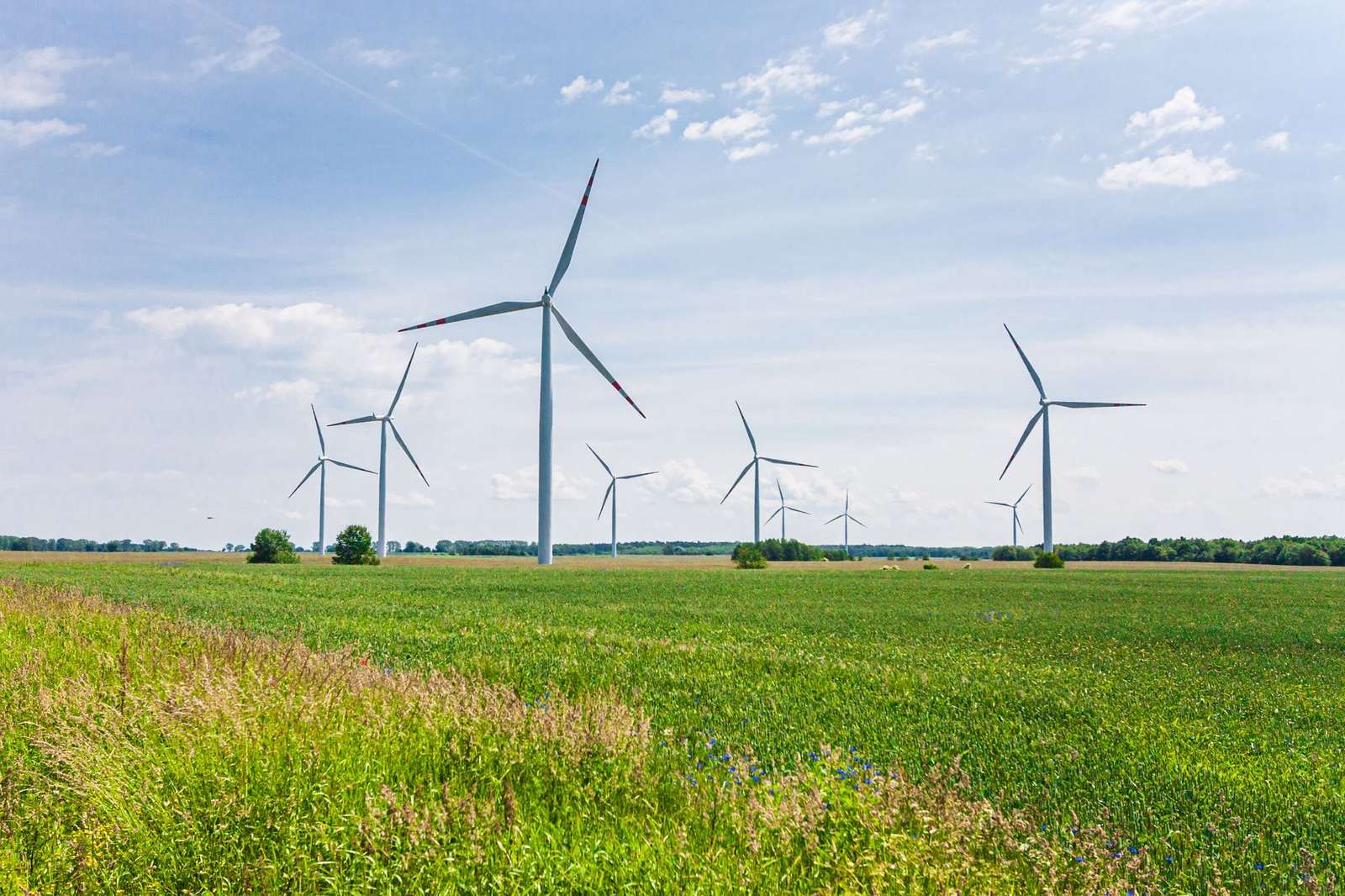
A wind turbine captures part of that motion. Turbines can stand on land or in large bodies of water, and the two settings are known as onshore (land-based) and offshore wind. The same page notes that land-based wind turbines range in size from 100 kilowatts to as large as several megawatts, and that larger machines are grouped together into wind plants that supply bulk power to the electricity grid.
Onshore and offshore projects differ in logistics. The Department of Energy notes that offshore turbines do not have the same transportation challenges as land-based installations, because the large components can be transported on ships instead of on roads. Onshore projects, in turn, avoid marine foundations and subsea cables, but they bring land-use and local-acceptance questions that are covered further below.
How a turbine converts wind into electricity
The principle is simple. According to the Department of Energy, wind turns the propeller-like blades of a turbine around a rotor, which spins a generator, which creates electricity. A turbine does not use electricity to make wind, as a fan does; it works in the opposite direction.
The blades behave like the wing of an aircraft. When wind flows across a blade, the air pressure on one side decreases, and the difference in pressure across the two sides creates both lift and drag. Because the force of the lift is stronger than the drag, the rotor spins. The rotor then connects to the generator either directly, in a direct-drive machine, or through a gearbox that speeds up the rotation and allows a physically smaller generator.
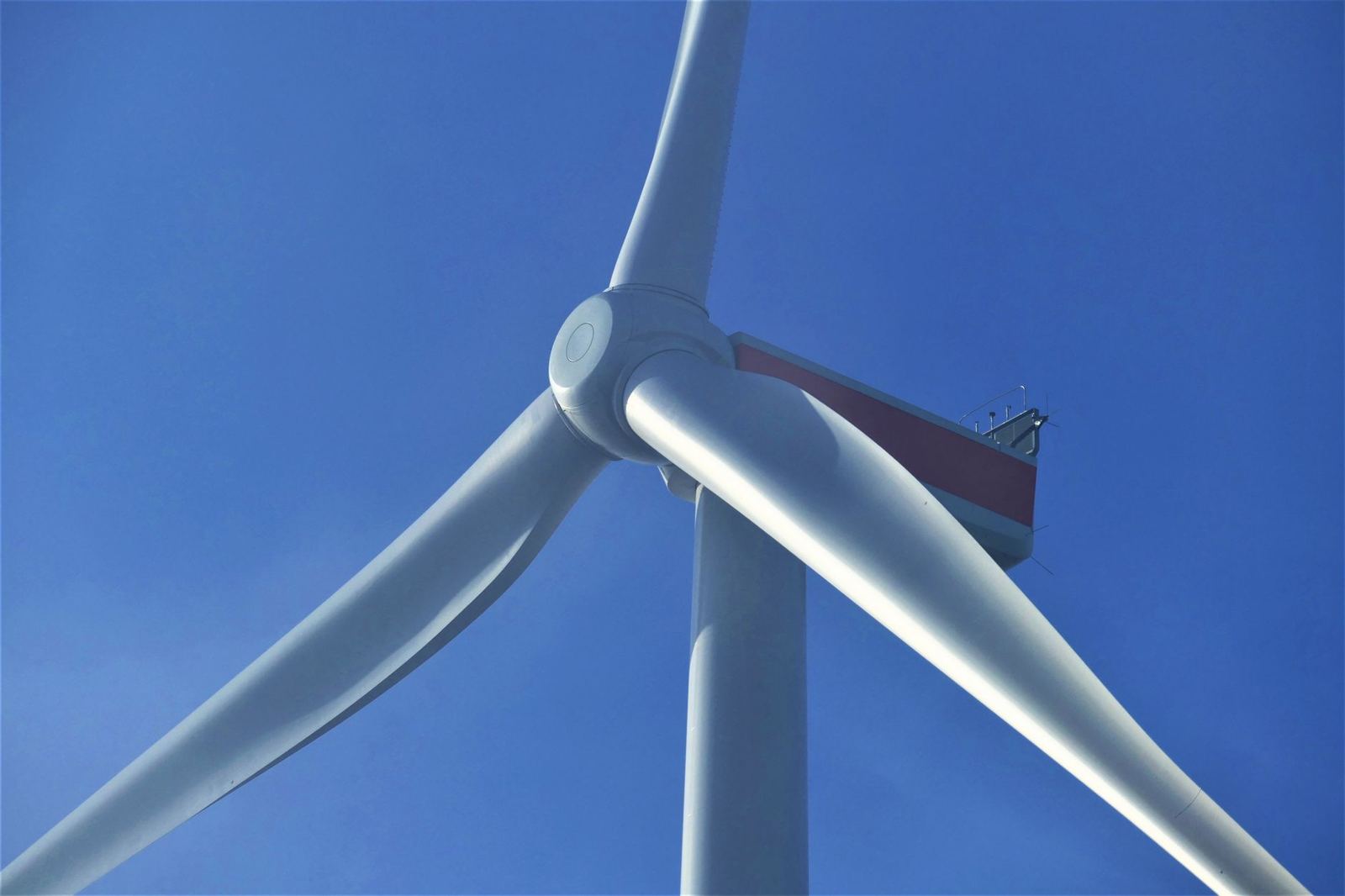
Most turbines seen on land are horizontal-axis machines with three blades, facing into the wind at the top of a tower. Vertical-axis designs exist, but they are far less common on wind farms. A modern land-based turbine has blades of over 170 feet (52 meters), according to the Department of Energy’s turbine guide, and the low-speed shaft attached to the rotor spins between 8–20 rotations per minute. That slow, powerful rotation is what a gearbox or a large direct-drive generator turns into electrical output.
Turbines also have an operating window. The controller starts the machine at wind speeds of about 7–11 miles per hour and shuts it off when wind speeds exceed 55–65 miles per hour, so that strong gusts do not damage the equipment. Between those limits the pitch system adjusts the blade angle to manage rotor speed.
Main components of an onshore turbine
A turbine looks like a single tall mast, but it is a complex machine. The Department of Energy notes that a wind turbine has as many as 8,000 different components. A handful of them do most of the work:
- Tower. It lifts the rotor into stronger and less turbulent air. Because wind speed increases with height, taller towers enable turbines to capture more energy and generate more electricity, as the turbine guide explains.
- Blades and hub. The blades, made mostly of fiberglass, and the hub together form the rotor.
- Nacelle. The housing on top of the tower contains the shafts, generator, brake and, in geared machines, the gearbox.
- Pitch system. It rotates each blade to control how much energy the rotor extracts and can feather the blades to slow the rotor in very high winds.
- Yaw drive. It rotates the nacelle so that an upwind turbine keeps facing the wind when the direction changes.
- Controller and sensors. A wind vane and an anemometer measure direction and speed, and the controller acts as the nervous system of the machine.
Two drivetrain layouts dominate. A geared turbine uses a gearbox to raise the shaft speed for a conventional generator. A direct-drive turbine connects the rotor straight to a large generator, and the Department of Energy says this approach can increase efficiency and reliability by avoiding gearbox issues. Operators choose between them on cost, weight and maintenance experience.
From turbine to grid: how a wind plant works
Single turbines exist, but most onshore capacity is built as wind plants, also called wind farms. The Department of Energy describes the chain this way: in a utility-scale wind plant, each turbine generates electricity which runs to a substation where it then transfers to the grid. Inside the plant, cables collect power from every machine. At the substation a step-up transformer raises the voltage, which reduces the losses that occur when large currents travel long distances.
Choosing where to build is a data-driven task. When developers plan a new plant, the department’s resource assessment page says they rely on location-specific data regarding wind speed, meteorological patterns, terrain, and other factors to inform siting and design decisions. Access to a grid connection matters as well, since the windiest land is often far from the places that use the power.
Output follows the weather, so a wind plant does not deliver a constant supply. Grid operators plan around this by combining wind with other generation, storage, interconnections and flexible demand. Forecasts of wind speed let them schedule other resources ahead of time, and the controller on each turbine reacts in real time to changing conditions.
Where onshore wind stands in Europe
Wind has been central to the European Union’s renewable build-out. The European Commission’s wind energy page reports installed wind capacity of 219 GW in 2023, 231 GW in 2024 and 246 GW in 2025, covering onshore and offshore turbines together. It adds that wind energy accounted for 37.5% of renewable electricity generation in the EU in 2025, and that the average onshore wind turbine now generates enough electricity each year to power over 1500 EU households, with newer models supplying more than three times as many.
The same page says the wind industry provided around 380 000 jobs in the EU in 2024, and it states that the growth is still not enough to meet the energy and climate targets set for 2030. To speed up deployment, the Commission’s Wind Power Action Plan includes an initiative on permitting; its first action announced the Accele-RES initiative to accelerate permitting. Slow permits, grid connection waits and local opposition are the main reasons new onshore projects take years to reach operation.
Turbine size is also rising. The Department of Energy reports that the average capacity of utility-scale wind turbines installed in the United States in 2023 was 3.4 megawatts (MW) in its list of wind facts. Larger rotors on taller towers reach steadier wind, so each machine produces more electricity from the same site.
Advantages and limits of onshore wind
The Department of Energy’s overview of advantages and challenges gives a balanced picture. On the positive side, wind provides electricity without burning any fuel, land-based utility-scale turbines can provide low-cost energy, and wind projects deliver state and local tax payments and land-lease payments each year. In a separate list of wind facts, the department reports that U.S. power contracts signed in recent years ranged from 1.4–5.5 cents per kilowatt-hour, with an average of 2.5 cents per kilowatt-hour; this is a U.S. range and not a European one.
The challenges are equally concrete:
- Remote sites. Ideal wind sites are often in remote locations, so new transmission may be needed.
- Noise and appearance. Turbines produce noise and alter visual aesthetics, which shapes local acceptance.
- Wildlife. Wind plants can impact local wildlife, so careful siting and ongoing research are required.
- Variability. Output depends on the wind, which calls for flexible grids and storage.
None of these points is unique to wind, since every energy source has land, grid and environmental trade-offs. What stands out is that most of them can be managed through siting, design and system planning.
How onshore wind fits with other technologies
Wind rarely works alone. On a typical grid it is paired with solar power, because the two resources often peak at different times of day and in different seasons. Land use can also be shared: turbines occupy only a small part of a site, and farming can continue between them. A related idea for solar panels is covered in the article on agrivoltaics, which combines crops and photovoltaics on the same land.
Wind electricity can also feed other energy carriers. When supply exceeds demand, surplus power can be used in electrolysers, a route explained in the article on green hydrogen. This links onshore wind to industries that cannot easily switch to direct electricity.
Frequently asked questions
What is the difference between onshore and offshore wind?
Show answer
Onshore turbines stand on land, while offshore turbines are installed in large bodies of water such as oceans and lakes. Offshore machines tend to be larger and need marine foundations, but their components can be shipped instead of trucked.
Why do turbines usually have three blades?
Show answer
Most turbines used for electricity generation are horizontal-axis machines, and the Department of Energy notes that they most commonly have three blades and operate upwind, with the nacelle pivoting at the top of the tower so the blades face into the wind.
What happens when the wind is too strong?
Show answer
The controller shuts the machine off when wind speeds exceed 55–65 miles per hour, and the pitch system can feather the blades so they do not produce force that would spin the rotor, as the turbine guide describes.
Does a wind turbine need gears?
Show answer
Not always. Geared turbines use a gearbox to speed up the shaft, while direct-drive turbines connect the rotor straight to the generator, which avoids gearbox issues.