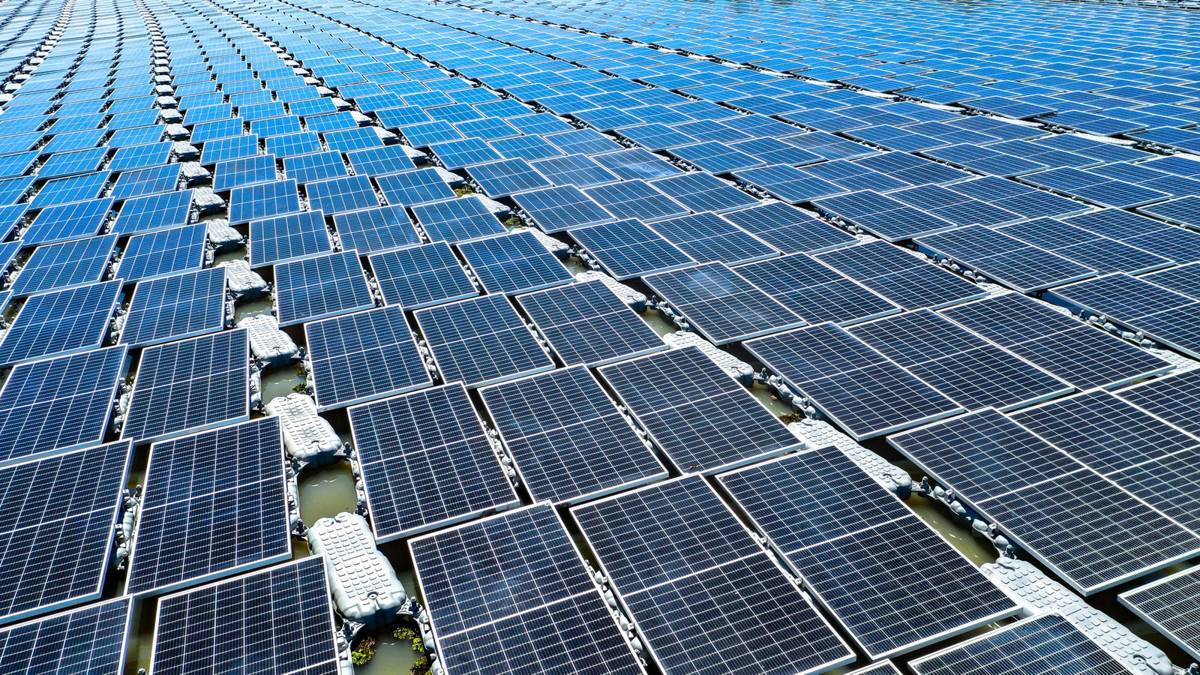
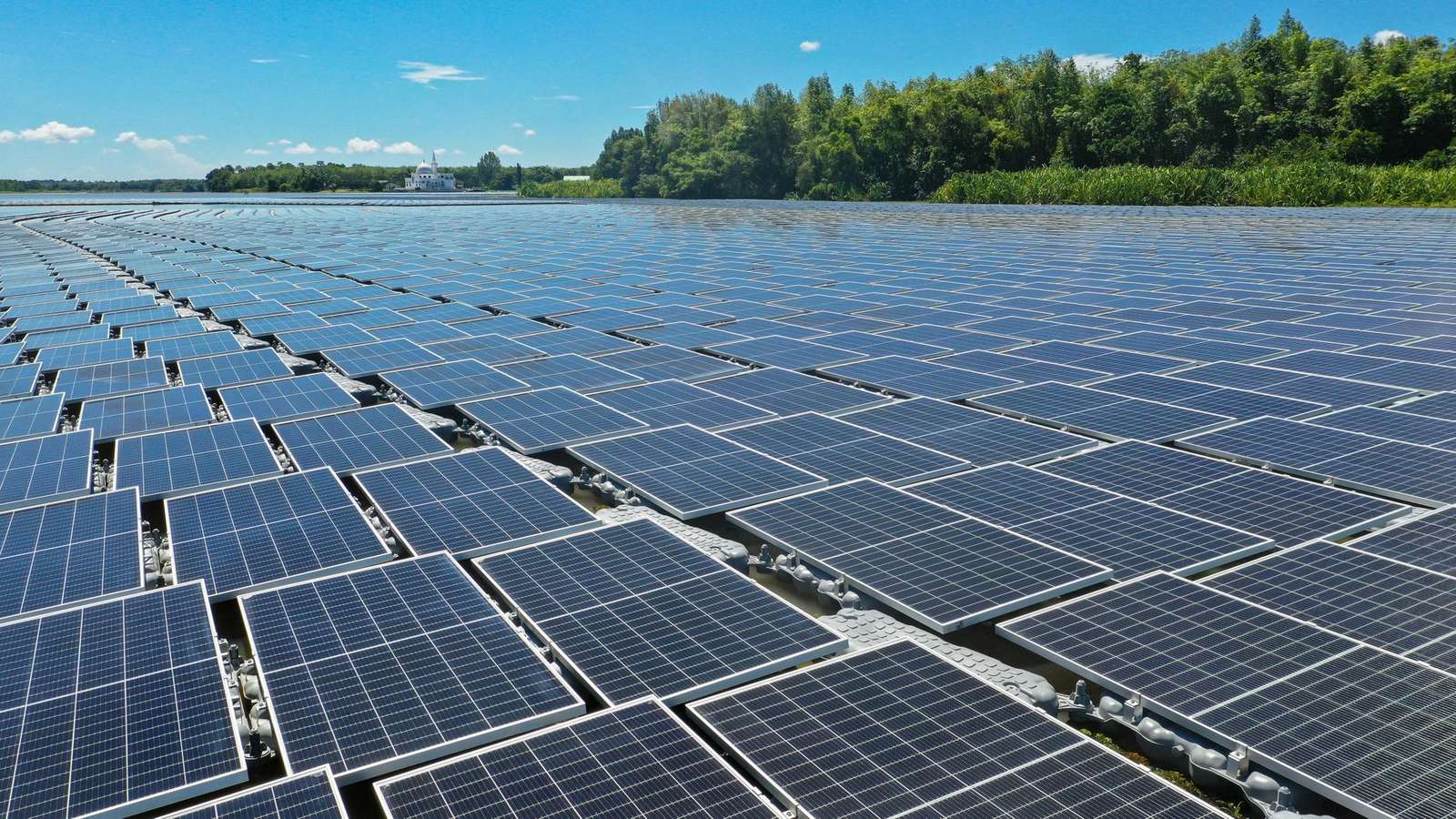
Floating solar is a photovoltaic plant mounted on buoyant platforms that sit on a lake, reservoir or other still water body instead of on land. Its appeal is that it uses water surface rather than land.
It is one branch of the wider renewable build-out covered in the renewable energy guide, and it matters most where land is scarce or where an existing water body already has grid access. The table below summarises the key figures.
| Item | What the source says |
|---|---|
| Global capacity | Grew to 1.1 GW by September 2018 from 10 megawatts (MW) |
| Technical potential | Estimated at 400 gigawatts, roughly all solar PV worldwide in 2017 |
| Hydropower reservoirs | Only 3-4 percent cover needed to double dam electricity generation capacity |
| Cost over time | At par with traditional solar PV |
| Open challenges | Possible water quality effects and anchoring and mooring complications |
| Upper Rhine lake study | 73% less irradiance at the lake surface under the array |
Figures come from the World Bank report page and a Scientific Reports study; this information can change, so check the sources for current details.
How a floating PV plant is built
A floating array uses the same modules and inverters as a ground-mounted plant. What changes is the foundation. Modules are fixed to floats, usually plastic pontoons, that are linked into rafts. The rafts are held in position by an anchoring and mooring system that is tied to the bank, to the lake bed, to piles, or to a combination of these. The mooring design depends on wind load, float type, water depth and how far the water level swings over the year.
Cables run from the rafts to inverters, which sit either on the floats or on the shore, and then to a transformer and the grid connection. Because the surface is flat and the rafts need no levelling or concrete foundations, site preparation is lighter than on land, and the arrays can be assembled in modular blocks. Sheltered inland water is the simplest setting; near-shore and offshore sites bring much heavier mechanical loads.
Where the market stands
Floating solar started as a niche. The World Bank reports in its Where Sun Meets Water market report that global installed capacity stood at 10 megawatts at the end of 2014 and had grown to 1.1 GW by September 2018. Fraunhofer ISE puts the worldwide total at over 7.7 GW in 2023 in its floating PV guide, a rise from roughly ten megawatts in 2014.
The same World Bank report estimates the global technical potential, under conservative assumptions, at 400 GW, roughly the entire solar PV fleet installed worldwide at the end of 2017, as stated on the report page. Growth has been strongest in Asia, where land is tight and large reservoirs are common, but Europe now has a growing pipeline too.
Benefits over land-based solar
The case for floating solar rests on a handful of advantages, each of which depends on the site.
- No land take. Plants use water that is already there, which avoids land purchase and competition with farming or housing. Flooded quarries, gravel pits and industrial basins are common sites.
- Cooler modules. Water and moving air keep module temperatures lower. A measurement cited in the Fraunhofer ISE guide found a 3.5 °C temperature difference between a floating and a land-based system, which led to an efficiency almost two percent higher. The guide also notes that results on thermal behaviour are often specific to a site or design, so they should not be generalised.
- Less evaporation. Shading and reduced wind over the surface can lower evaporation from reservoirs, which is a particular advantage for drinking-water and irrigation storage in dry regions.
- Use of existing grid access. Many reservoirs already have a substation and a transmission line, so the connection cost can be low.
- Hydropower synergy. The World Bank notes that at some large hydropower plants only 3-4 percent of the reservoir would need to be covered with floating solar panels to double the dam’s generation capacity, according to its market report page. Solar can be used first during the day while the turbines hold back water for the evening peak.
Costs and economics
Floats, mooring and specialised cabling usually mean a higher upfront cost than a comparable ground-mounted plant. The World Bank argues that the costs over time are at par with traditional solar PV, because the higher energy yield offsets part of the extra capital cost, as set out on the same report page. How far that holds depends on mooring depth, water-level variation, local float supply and financing terms.
For project owners the revenue side looks the same as for other solar assets: output is sold on the spot market or under a long-term contract such as a solar power purchase agreement. A floating plant on an industrial lake can also supply the operator’s own site, and Fraunhofer ISE singles out industrial water bodies such as gravel and dredging lakes as especially promising because the solar power directly decarbonises the operator’s industry. A related option is to use cheap surplus output to make green hydrogen next to the water body, although this remains at the planning stage in most places.
Limits and environmental questions
Floating solar is not suitable everywhere, and the evidence base is younger than for land-based PV. The World Bank report page lists several open challenges: the lack of a long-standing track record, possible effects on water quality, complications related to the anchoring and mooring of installations, and the relative complexity of maintaining some parts of the installations, in particular the electrical components (World Bank).
Effects on the water body
A peer-reviewed study in Scientific Reports measured a plant on a deep dredging lake in the Upper Rhine Valley. Underneath the array it found a 73% reduction in irradiance at the lake surface and an average 23% reduction in near-surface wind speed at module height.
Mechanical and operational stress
Sheltered inland water is the easy case. Fraunhofer ISE notes that offshore systems operating in unprotected water with significant wave heights above 2 m face strong winds, high waves, salt corrosion and biofouling, and need more robust materials and flexible platforms (Fraunhofer ISE). Even inland, birds can be a problem: the guide flags that bird droppings can damage modules and lead to hotspots, so regular inspection and cleaning are needed.
Access for operations and maintenance is also harder than on land. Technicians reach the rafts by boat or by walkways, and inspection routines have to account for arrays that move with the water.
Floating solar in Europe
Europe has fewer large water bodies suited to the technology than Asia, but flooded mining pits, gravel lakes and hydropower reservoirs offer a steady supply of sites. According to the Fraunhofer ISE guide, a plant in Haute-Marne in France, with an installed capacity of 72.3 MWp, is currently the largest in Europe. The same document lists Germany with 44.2 MWp of floating PV in operation.
The German potential is substantial but bounded by law. At a surface coverage of 15 percent, the guide calculates a potential of 13.7 to 19.1 GWp. National rules limit coverage of a water body to 15 percent of its surface at mean water level and require a 40 m setback from the shore, which is why the coverage figure is used in the calculation (Fraunhofer ISE).
Permitting is the main brake on growth. Fraunhofer ISE notes that environmental impact assessments or extensive environmental monitoring often play a key role in approvals, because the effects on water bodies are still little researched.
Frequently asked questions
Does floating solar produce more electricity than land-based solar?
Show answer
Often a little more, because cooler modules run more efficiently. One measurement cited by Fraunhofer ISE found an efficiency almost two percent higher. The result depends on the site and the design.
Can floating solar be installed on the sea?
Show answer
Yes, but near-shore and offshore systems face waves, salt corrosion and biofouling, so they need sturdier platforms than systems on sheltered lakes.
Does a floating plant harm the lake?
Show answer
Effects depend on how much of the surface is covered. Studies measure less light and less wind at the surface, and a shift in summer stratification. This is why regulators set coverage caps and ask for monitoring.
Why combine floating solar with hydropower?
Show answer
The reservoir is already connected to the grid, and the two sources complement each other: solar generates by day while the hydropower plant can store water for the evening peak.